
How can European manufacturers become more flexible, resilient and better prepared to respond to changing market conditions and supply-chain disruptions?
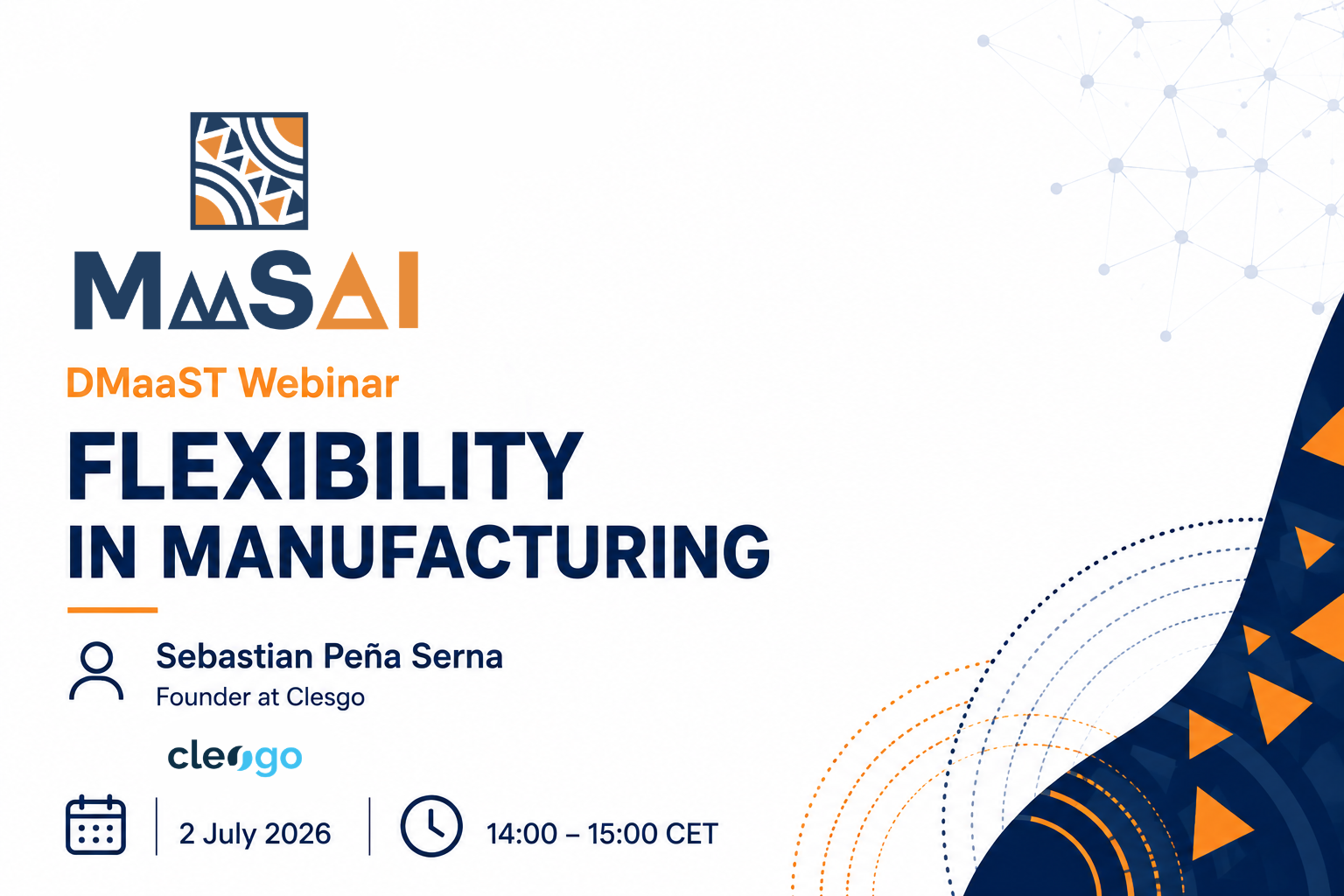
On 2 July 2026, the DMaaST project, in collaboration with MaaSAI, organised the webinar “Flexibility in Manufacturing”, bringing together 43 participants from industry, research and the European innovation community.
The webinar explored how digital technologies can support manufacturers in responding more effectively to changing demand, disruptions and sustainability challenges. The discussion highlighted the importance of trusted data, interoperability, Manufacturing-as-a-Service (MaaS) and advanced digital solutions in shaping more flexible and resilient European manufacturing.
The MaaSAI perspective: from flexibility to Manufacturing-as-a-Service
MaaSAI was represented by Sebastian Peña Serna, Founder of CLESGO, who introduced the MaaSAI vision and its contribution to the future of Manufacturing-as-a-Service.
For MaaSAI, flexibility goes beyond adapting production within an individual factory. Manufacturing-as-a-Service opens the possibility of accessing manufacturing capabilities across a wider industrial ecosystem, connecting companies that need specific capabilities with manufacturing providers able to offer them.
MaaSAI is exploring how AI autonomous agents, digital technologies and secure data exchange can facilitate these interactions and help make manufacturing capabilities more accessible on demand.
Trusted data and interoperability as foundations for flexibility
One of the key themes emerging from the webinar was the role of trusted and interoperable data.
Manufacturing environments generate large amounts of information, but flexibility requires that relevant data can be exchanged and understood across different systems and organisations. At the same time, companies need to maintain appropriate levels of trust, security and control over their industrial data.
These questions are particularly important when moving from individual factories towards more connected manufacturing ecosystems.
Collaboration across the manufacturing ecosystem
The webinar also highlighted that manufacturing flexibility cannot be addressed by technology alone.
More responsive manufacturing requires collaboration across companies, technologies and value chains, supported by digital solutions capable of facilitating information exchange and industrial cooperation.
This is closely aligned with MaaSAI’s ambition to develop a digital ecosystem where manufacturing providers and consumers can discover capabilities, exchange information and collaborate more dynamically.
The session concluded with a round-table discussion in which the speakers exchanged views on the opportunities and challenges associated with increasing manufacturing flexibility and answered questions from participants.
Watch the MaaSAI presentation
We would like to thank Sebastian Peña Serna and the CLESGO team for representing MaaSAI and bringing the project’s Manufacturing-as-a-Service perspective to the discussion.
🎥 Sebastian’s MaaSAI presentation is now available:
Watch Sebastian Peña Serna’s presentation
The complete webinar recording is also available through the DMaaST project.
Watch the full Flexibility in Manufacturing webinar
Towards more agile manufacturing
The discussion on flexibility will continue as MaaSAI develops and integrates its technologies and tests them through its industrial use cases.
By combining Manufacturing-as-a-Service, AI autonomous agents, interoperable industrial data and secure digital technologies, MaaSAI is exploring a future in which manufacturing resources can be used more dynamically across connected industrial ecosystems.